Tuesday, July 19, 2011

Long Vacations and My First Story

Photo: Claudio Fuentes Madan


I spent weeks debating with myself about taking a serious break from Octavo Cerco. I don’t want to be melodramatic but it is surprising how what began as an exercise in personal freedom has been transformed into a tremendous responsibility. I don’t like it to be so. Because I write because I because it keeps me grounded and not because a week has gone by since I posted.

I finished my personal debate, and have come to the basic conclusion that it’s time for a rest. Between the government, summer and the island I almost lost control last week. No way. I am going to sleep 12 hours a day, and try to stop smoking, take a break from the National News on TV and the newspaper Granma (these last two measures are an imperative for me), and I am going to finish my second story.

Meanwhile, I ask for the forgiveness and understanding of everyone (the trolls and other vermin on the network: don’t chew your fingers, it’s just a little break) and I leave you Pavimento, my first little story, published in Number 8 of Voices magazine, under the pseudonym of Dalila Douceca.

Saturday, July 2, 2011

Gimme Light

I’m so accustomed to the lack of information in our media that when I hear a story, not just of current national or international importance -- as one can’t ask for so much -- but of something as simple and useful as the repairs that occasion power outages, or about water shortages in certain areas of the city, I’m surprised. By the way, this kind of information -- highly advantageous for making life easier for citizens -- is only aired on the Havana channel. Sadly, I don’t get that channel at my house so I’m obliged to watch it when I’m visiting friends. 

A few weeks ago I heard on the news for the first time a detailed explanation of the water shortages we inhabitants of Havana are suffering, particularly in the central neighborhoods and of course in Vedado where I live. It even made me happy, because they’ve always treated us so badly that the mere fact of announcing a lack of drinkable water during certain hours is appreciated. In general, you wake up one day to no gas, or water, or electricity, and you don’t know why. With any luck, you discover the cause of the failure several hours later.

I prepared, obviously, for the following day and filled my reserves: buckets and plastic jars adorned my kitchen and my bath to weather, as best as possible, the absence of the vital liquid. But when the sun came up I was surprised to find water in the pipes, and by mid-morning -- don’t let anyone believe that in Cuba this comes as a surprise -- the lights went out and didn’t come back on until dawn of the following day. In the end, I don’t even regret not hearing any information about the shortages that affect us, I prefer the confusion of filling up buckets when I should be out buying candles.

Tuesday, June 28, 2011

What More Could One Ask For?

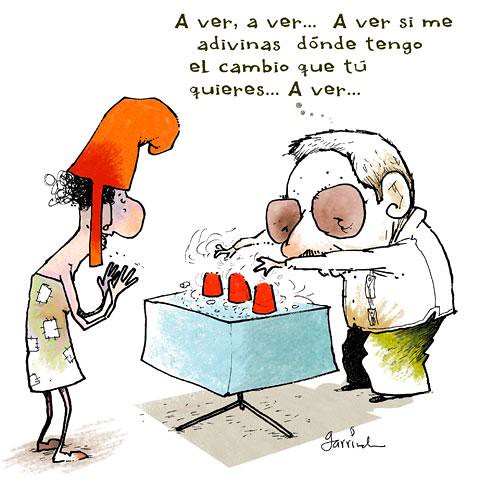
Images: Garrincha
By Boris Gonzales Arenas

Soon we'll have
according to our president
five-year terms
with an extension pending.

Raul said so after
meditating before the sewer
“there must be urgent changes
will two hundred years be enough?”

My uncle in Carlos III,
a descendent of slaves,
made a sure gesture,
that it itches and spreads. 

“It’s difficult to predict
when the bosses will get fed up
or when a sleeping people
will become enraged."
Watch, watch... see if you can guess where I have the change you want... Watch...

"They will add hovels
swarming the slums
and thousands of dissidents
judged as criminals"

"From the parading tanks
they will remove the treads
and put modern tires,
the war will be on the pavement.”

A group that philosophizes
doesn’t understand so much fallacy
thus it was named
it was called copropraxia.

While waiting
I drink my coffee
mixed with peas and beans
they will leave me without it

And at the end of all this
-- this poet asks --
through which sacred slot
do we shove them the ballot.


21 June 2011

Wednesday, June 15, 2011

Habits

Photo: Lía Villares
Everyone has their sillinesses, their addictions, their moments of relaxation. There are those who watch three soap operas simultaneously, others spend a great part of the day with their ears glued to the phone, and many--they tell me--would give an arm and a leg to be connected to the Internet twenty-four-seven; the latter suffer from an illness called “geographic misfortune.”  For my part, I don’t like soap operas, I have no time to talk on the phone, and of course, even if I wanted to, the Internet is a kind of platonic and impossible love I’ve longed for, for many years. I plan my Sundays punctiliously. As my mother says, “rain or shine” at half past nine in the evening I plop myself in front of the TV to watch the one series that interests me: CSI at the scene of the crime. It’s all the same to me if it’s in New York or Las Vegas, I’m an indisputable fan.

Last Sunday, five minutes late and remorseful for having missed the opening scene, I turned on the screen. I love it all: the music, the script, the characters and the technology they use. Can you imagine my face--it’s a shame I was alone--when instead of hearing the theme music by U2 that opens each episode, along with fast-paced editing, I find some sepia images and a Cuban cop, billy club and all, on the screen? At the same time, on the same channel, they decided to substitute for CSI a program called “In the footsteps,” a pathetic series produced by the Ministry of the Interior, all rights reserved and everything.

Beyond disappointing all the viewers--because the difference in quality between the two programs would be, lets say, the same as that between Playita 16, a rough little stretch of sand, rocks and concrete along the waterfront here in Havana, and the world-class beaches of the resorts of Varadero--they must be unaware of their own limitations.  Perhaps some standard-bearer could offer a phrase from Jose Marti: “Our wine is bitter but it’s our wine.” (I’d like to offer a joke, “Our wine is bitter, they must import it.”) But humility is also an exercise of intelligence and, obviously, is one of the virtues lacking at the Interior Ministry.

Friday, June 10, 2011

Floating in Nothingness

Yoani Sanchez
I have no desire to write. I scold myself. Since I learned that Coco Fariñas is on a hunger strike I have been floating above the city. I can’t even call him on the phone and only yesterday I managed to send him a message. I’m a coward. I hope I’m wrong, but I feel that at the Central Committee of the Communist Party they’re keeping a bottle of champagne, planning to pop the cork if he dies.

I spend my nights in front of the TV. I alternate between “The Halfway House” by Guillermo Rosales and the potato harvest. At times I have the impression that my life is one of the dreams of Rosales’ character William Figueras, where he was always Fidel Castro. I change the channel obsessively but always end up at the News or the Roundtable. Between Machado Ventura saying we need to end illegal housing in reserved zones (reserved for what? I wonder) and an ad about semi-mechanized agriculture (i.e. a peasant with a yoke of oxen) I can't contain my nausea.

I have a presentiment about the doctors’ statements--the cynicism and double standards of fear--false statements about the patient’s condition, the expense accounts of the intensive care wards, the lies about a criminal past, in short, a media lynching. I imagine us so small against the wall that sometimes I can’t breathe. Every day in the street someone says to me just a little bit longer and makes a joke, it’s the only thing that gives me the strength to go on.

Saturday, June 4, 2011

The Race

Photo: Leandro Feal
It happened in 1990 when he was seven. The world, although not perfect, was innocent and playful. His parents were doctors, working night and day and surviving badly during those hard years at the beginning of the Special Period. Many criticize only children and the personalities we develop as adults and he, in the end the only son, enjoyed all the love and mischief at home. In the mornings, Mom made breakfast and got him out of bed, Dad adjusted the seat of the Chinese model 28 bicycle and with the morning dew still on the grass, one left for the school and the other for the hospital.

At night the company alternated depending on the shifts: with Mom he read stories and with Dad he played on the floor. Sometimes in the middle of the night he would wake up at the sound of lock and see one of his parents arrive home in a white coat, bike in tow. Other times they pulled him out of bed at dawn to give him a goodnight kiss, having come home after three in the morning.

One night his father didn’t come home. It was nearly dawn when they received a call from the hospital: he was dead. It’s difficult to take in mortality at seven, but even worse to know the story of an absurd death. It turned out Dad was coming home on his bicycle on 26th, while some boys, untouched by the collapse of the Cuban economy, were racing their fathers’ Ladas along the Avenue. The cars racing full speed took the life of a man who had spent the night saving lives. The death was swift.

The culprits went to trial--oh yes!-- except for one small detail: they were acquitted of all charges, keeping their drivers’ licenses and everything. Perhaps they were not only children, but their parents had been given the task of spoiling them, and took pleasure in converting them into “The Sons,” the untouchables, those who can actually trumpet their races from one end of the island to the other and never pay for anything. People call them “Daddy’s children,” and compared to them, the myth of the only child is nothing.

Monday, May 30, 2011

VOICES 8

Voces 8

28 May 2011

Tuesday, May 24, 2011

Havana - New York

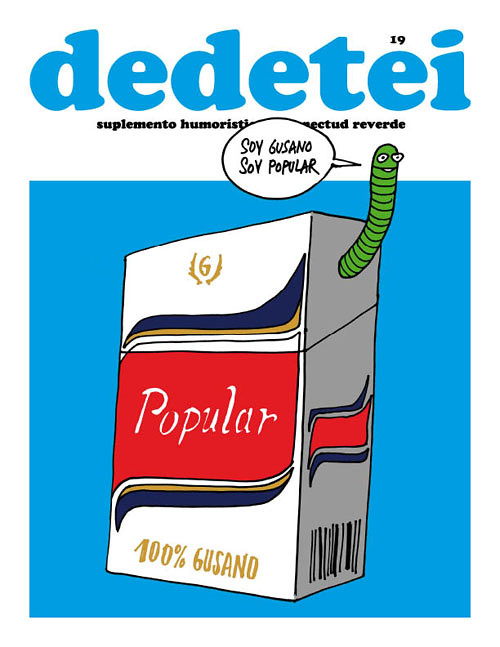
"I'm a worm*. I'm popular." [*Fidel's term for Cubans who leave Cuba.]
I met her in 2004, we had a mutual acquaintance, a neighbor of mine. She spent her life in clubs and at concerts, always with boys who came to collect her in a car. I liked her, she was fun. In the afternoons when she woke up sometimes she’d come and have coffee at my house. With her parents abroad, she lived without working and even though she was sometimes short of money, her nights out weren’t affected because the men paid. 

Chance, that had one day put us in the same neighborhood, separated us. For years I didn’t hear from her and thought, as is common on this island, that she’d left the country. Recently we ran into each other and I discovered I was right, she lives in New York now and comes to Cuba on vacation. I don’t know what happened, Cubans find so many ways to run away from this land that I don’t even take the trouble to inquire, though the stories can be funny, but also very sad and sinister. Also, I’m a little sensitive on the topic of emigration, wondering who will be here beside me in ten years, when all my friends have left.

In the short time we shared, she told me that she worked a great deal over there, and that generally speaking, she’s considered a communist. “Communist?” I exclaimed, “You were a big fat worm. What happened to you?”

“The system in the United States,” she said, “is inhumane, here it’s better, more humane.”

I looked at her with my mouth hanging open. She doesn’t like the new country where she lives because she has to work; in Cuba she didn’t have to because she was a kept woman. How can you use politics to justify your own inability to be productive?

“I don’t agree with you,” I said, trying to contain the passion that comes over me when people come from a democracy and tell me fairy tales about the dictatorship. “Sure, a lot of people don’t work because the salary is ‘inhumane’ and no one is interested in breaking their back for nothing. But still it seems very good to me that you have to work to earn your own bread. It’s normal.”

“Cubans don’t like to work,” she replied, and then I knew that because she didn’t want to work she assumed everyone else didn’t want to either. What a capacity for generalization!

Before we parted she told me she was about to have an operation. I assumed it would be in Cuba, given what a humane government we have. You can’t even imagine my surprise when she exclaimed, “No! I’m having it over there!”
Saturday, May 21, 2011

One More Number in the Statistics

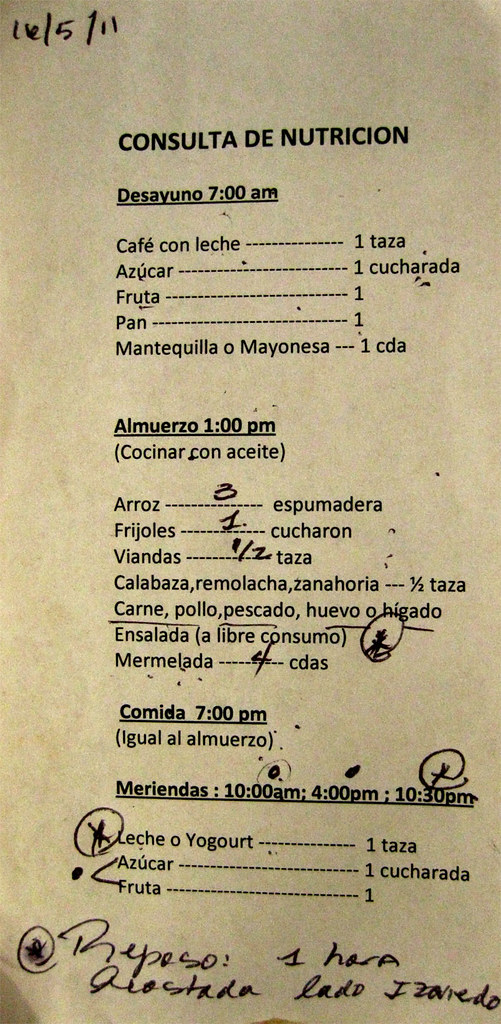
Breakfast: 1 C. coffee with milk, 1 tsp sugar, 1 fruit, 1 bread, 1 tsp. butter or mayonnaise. Lunch: 3 large spoons rice; 1/2 C. vegetables; 1/2 C. squash, beets, or carrots; meat, chicken, fish, egg or liver; salad, eat freely; 4 tsps. jam. Dinner same as lunch. Snacks: 1 C milk or yogurt, 1 tsp sugar, fruit. 
E. is 38 and pregnant. She feels like one more number in the statistics. The other day she called me when she was leaving the polyclinic to say she was coming over. They couldn’t do any more. Half the tests couldn’t be done because they didn’t have the reagents, even though they sent the prescription paper back smeared with someone else’s blood. She’d been up since five in the morning and at ten still hadn’t had breakfast, and to top it off the doctor asked her, “Honey, why did you wait so long to give birth? Now I have to do an electrocardiogram.”

The first thing she said when she saw me was, “I thought the state of education was bad, but now that I’ve come up against the public health system...” E. is like me, very small, but much skinnier. Before her pregnancy she weighed 89 pounds and now, at two months, she weighs 113 and her hemoglobin count is 12.5. Still, the nutritionist thinks she is underweight and has recommended “moving into a maternal home.” She gave her a copy of a diet to follow to the letter. When she showed it to me I started to laugh, but to her there was nothing funny about it.

She has to get up at seven in the morning to have breakfast and this first meal of the day includes a tablespoon of mayonnaise, whose nutritive properties are unknown to me. Throughout the day she must must meet the standard of six large spoons of rice and two ladles of beans (half at lunch and half at dinner, every day until the baby comes). Meat is not defined by quantity and she must eat a half cup of guava jam every day.

I wonder if the diet is to nurture her or to fatten her up. Probably the doctor isn’t authorized to recommend eating certain products like meat or much fish, but at least they should have the decency not to put pregnant women on diets designed to fatten turkeys to make foie gras. In response to the psychologist’s long awaited, “How do you feel?” E. answered, “Fine, but I’d feel better if I didn’t have to come to this polyclinic any more.”

Tuesday, May 17, 2011

A Day Abroad

Photo: Leandro Feal
She arrived in Cuba at the end of the seventies in love with the Revolution. She married a general and settled in the island paradise to make her dreams come true. She always rubbed elbows with the higher-ups, the so-called Nomenklatura, and spent the last thirty years as if she were a princess. Perestroika, Glasnost, the fall of the Berlin Wall and later the collapse of the Socialist block came to her like echoes from distant Europe, which she had wisely left behind.  From her house in Siboney she heard the litany of the Special Period, but when she drove her Lada down Fifth Avenue things didn’t look so bad. Though the electricity often went out she bought a generator and, as always, her husband supplied the home bodega with imported products. The same as always.

She made some women friends, almost all from the Communist Party. But by the beginning of the new century few remained in Cuba and all had given up their political posts and the Party. Politics had never been a topic of interest among them, rather food, creams, the beach and the good life. Gradually the shortages invaded their conversations: Who cared about the blue sea and the white beaches of Varadero if there wasn’t even an egg to put on the table? This animal of discord, this political beast, wouldn’t leave her alone.

One day she decided to give her friends a special day: the beach, a restaurant, a hotel. They left early in the morning and returned late at night. When they got out of the car one of them said with satisfaction, “Thanks for this marvelous day abroad!” It was the last time they saw each other.

Monday, May 9, 2011

The Student

Photo: Claudio Fuentes Madan
How do I relate the horror? The last image I have of Juan Wilfredo Soto Garcia is of him at my side running around under the Santa Clara’s relentless sun. We tried to get permission from the Bishop so that Padre Dominico--who had come halfway around the world to get to Cuba--could go see Guillermo Fariñas in Intensive Care at the scheduled visiting hours. At the church they told us that State Security was in charge of giving out permissions, and at State Security they told us it was the Bishop.

Now I look at the photo in Penultimos Dias of the Student and I don’t recognize him. It must be that I refuse to accept that they beat him to death. It must be that I can’t admit that this time of horror has come to this Island. I must be that I don’t have the ability to look death--murder--in the face. And I ask myself--is it the obvious uncertainty of rationalism--how many Wilfredos have there already been and how many are still to come? While sitting in a park, an incomprehensible crime, the massive weight of half a century of police impunity falling on his body.

Anonymous faces in blue. For a long time people have feared them more than the thieves, scammers and criminals. “Call the police” has become the last card in the deck. Because justice does not come with them. Because they are not here to protect us, but to control us at any price. Because they are corrupt and they are unafraid to dirty their hands, which in any event are almost all already dirty.

What are we going to ask of the National Revolutionary Police now that we have seen them force into a patrol car of the “new” State power the former Minister of Health, “compañero” Balaguer with his line of twenty-six dead of starvation and cold at the psychiatric hospital; now that we have seen the government, on national TV, justify the death of a man on hunger strike? What can we ask of the police except that they not kill us?

Tuesday, April 26, 2011

Necessities

If you don't eat all the potatoes I'll take you to the Internet. Image: Lázaro Saavedra

Since that time on one of the campuses of the University of Havana when I raised my hand to express a doubt about the Marxist categories of necessity versus chance, the concept surrounds me. I have come to the conclusion that human needs are complex enough that the specialists must abrogate the right to “suppress” some of them in our lives.

We have Elaine, Cuban blogger, who assumes her grandfather doesn’t need the Internet. Sadly, she’s not alone. The other day someone assured me that for a Cuban farmer the Internet is not a priority. What is the priority? Undoubtedly in the Middle Ages electricity was not one, and for Cro-Magnon man what we now call “staple products” were in short supply. Why do we insist on establishing boundaries to human welfare? I wonder why it’s a problem to assume access to the Internet as a 21st Century human right. Whether the farmer is connected so he can study the market for new fertilizers for the earth, or so he can chat on a boy-meets-girl site is immaterial; what matters is his right to access the World Wide Web and what it represents for his personal life. Any “supposition” about what a farmer should do on Google, or in the furrow, is called control over the free actions of another, personal choice and individual freedom.

Of course reducing world poverty is an imperative, but I honestly don’t see the connection between that and the right of Cubans to have private accounts for Internet access. Social inequality in the world does not justify Raul Castro getting to decide that I can’t open my Facebook whenever I want. Isn’t it obvious? Or am I going crazy?

Friday, April 22, 2011

The Same Names

"This last Congress has been historic!" "Why...? Is it really the last?" Image: Garrincha

When I look at the images of the Sixth Congress the irrationality startles me. When I hear the list of delegates, the members of the Politburo and the Central Committee, I feel physically sick: Machada Ventura, Balaguer, Cintas Frias and an elderly etc., prevent me from continuing to listen objectively. To top it off, Raul Castro decides to tell a story about family machismo which seemingly belongs in a Mexican soap opera: he cuts Machado Ventura off after some brief gossipy chatter. Certainly this scene would have been more appropriate in front of the kitchen stove than at the long-awaited Communist Party Congress.

The worst -- or best, depending on your interpretation -- is that we have to wait until January 28, 2012 to implement the changes. It was assumed that the super-change would be now, but they give us a tiny-change and once again postpone the big-change. Raul Castro laments the archaic dogma, promises (another) rectification, predicts a future of younger leaders and assures us that, slowly, socialism and the revolution will be saved. The General knows, he has to know, that his promises will be fulfilled only when he is no longer on the Central Committee, when he is no longer First Secretary of any party, when a truly new wave of public officials assume power. And it is precisely this that is the imperative of the powerful elderly: minimize change and play a politics of drop-by-drop, to put off as long as possible the inevitable change, the end of the Party’s omnipresence.

But even I, the Queen of Incredulity, feel a certain optimism. The economic freedoms that the Cuban government is now forced to concede at the risk of “collapse” will be the foundation of social and political freedoms that we will snatch from them tomorrow. Because then, too, they will be compelled to concede, otherwise they will perish.

Tuesday, April 19, 2011

Me? A Soldier?

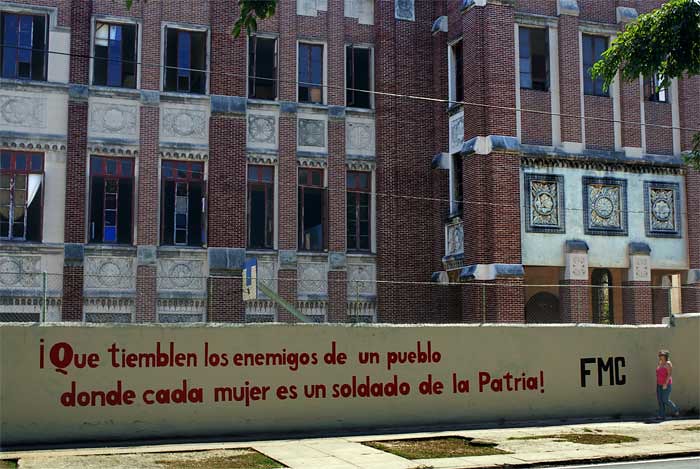
Let the enemies of the people tremble where every woman is a soldier for the Fatherland. FMC = Cuban Women's Federation
Every time I pass by 21st and Paseo it turns my stomach. A cross the street and I can’t help but read the enormous sign that illustrates this post. Signed by the Cuban Women’s Federation (FMC), it gives the idea that I all the women of the island are some kind of army ready to fire on the enemy. I’m not even a soldier of my own causes, how could I be one for the causes of the FMC?

It bothers me greatly that the multiple mass organizations which supposedly represent groups of Cubans feel like they have the right to speak for everyone, robbing individuals of their voices to make them into the single voice of the apparatus of control. Why are we urged to a militancy that we don’t need? Who said I’m not a die-hard civilian? Since when did we Cuban women form a battalion for the defense of the fatherland?

Saturday, April 16, 2011

Saturday


Since Friday, April 8, the heavens have announced to us the march is coming. Under beautiful blue the war planes rehearse, it’s not clear what or why, and down here on the ground we cover our ears against the roar. My dogs are losing sleep, the male barking desperately at the ceiling and the female cowering under the sofa. I wish I could explain to them that it is nothing more than a deployment of military vanity in a country tired of repeating to the world that it condemns war. I go out into the street and am surprised to see some tanks file past right before my eyes.  I cross 26th Avenue and breathe deeply, it’s a fact: this island is governed by madmen. Traffic is diverted and the cars lost in the alleyways are a mess. I spend fifteen minutes trying to cross Paseo.

For ten days I’m living in a countdown: minus seven, minus five, today, finally, minus two. Never have I been so desperate for the coming of a Sunday. From Friday, everything will be paralyzed, schools, businesses, the city. With so much need and such a crisis I wonder how many zeros there are on the price of the mega-march for the fiftieth anniversary of the Bay of Pigs.

We Cubans say we are paranoid, and honestly, if we weren’t we’d be really sick, because there is nothing more chilling than to stand on the balcony and see a squad of soldiers screaming obscenities and stomping the ground, nor more theatrical than an army mobilized in times of peace, nor more irrational than taking men from their jobs to mobilize the reserves several times a year. Nothing as sad as this week, reminding us, mercilessly, that it is not the war of a whole people, but the war against a whole people.