Wednesday, October 20, 2010

Moderating Comments

There’s nothing better than a new day to demonstrate that our decisions are not infallible.  I’ve been watching my own evolution with respect to the moderation of comments. First I swore I did not want to moderate them. Then that I would like to but I could not. And now, that I will, as I have found a way to do it through a friend.

I recently wrote that all I knew about my political leanings was that I was not a communist; thanks to the comments on Octavo Cerco I have discovered that I am not an anarchist. Little by little one comes to find oneself.

I have spent several days trying to flesh out the rules for the forum, and here they are.  Any suggestions, of course, are welcome.
  • Every commentator is responsible for his comments (even if he is a G2 agent and is following orders. Sadly, now with moderation, some will become “dispensable”).
  • Comments entirely in capital letters will be erased. In the language of cyberspace that means you are shouting and my blog is not a platform for virtual repudiation rallies.
  • Any offensive or insulting comments, or threats against other commentators, will be erased (exercising your right to privacy, do not publicly strip the skin off of others).
  • 
 Comments that incite violence will be erased (my resistance is peaceful, if you want to rise up in the Sierra Maestra open your own blog before you take off for Pico Turquino).
  • Comments that contain more than two links will be moderated to prevent spam.
  • Repetitive comments will be erased (it’s bad enough with Granma having to read the same thing over and over again).

  • Comments that usurp someone else’s identity will be erased (I do not care for aspiring secret agents).
  • Comments that do not use the Roman alphabet will be erased (even if I could translate them, it takes too long).
I think that’s it and I hope you can live with it.


Sunday, October 17, 2010

The Fear of Being Wrong

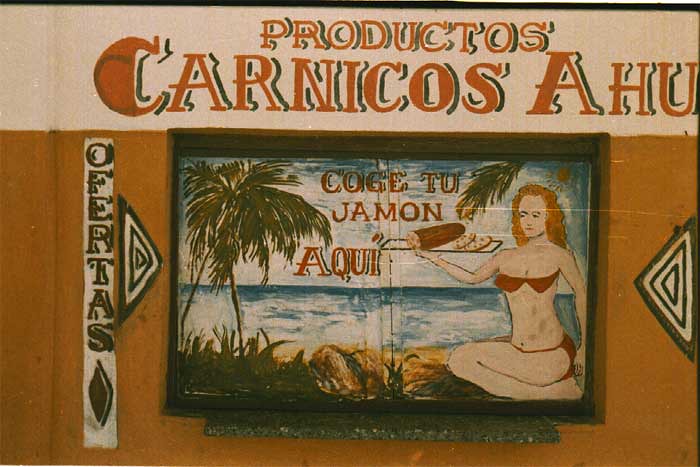
Photo: Leandro Feal

It’s hard to have a conversation these days without landing on the topic of “The list of the 178,” that is the new list of the approved “self-employment occupations.” I personally would like a summary of the most popular occupations of the 16th century, but I know I’m one of the pessimists. Fine, my debate partners tell me that I am among the “pessimists” but to me I’m among the “obvious realists” because for how long are we going to “improve the system”? They say “socialism” but I refuse to call a government socialist that in less then two years plans to lay off a million workers, that has raised the retirement age, that has decreased the number of products euphemistically called “subsidized” and that hasn’t even remotely considered raising wages, not to mention the Sword of Damocles that the dual currency represents in our economy today. I am not going to talk about economic, social or political freedoms because, obviously, for those who consider the Cuban model a socialist model, these freedoms seem something like a capitalist class, or am I mistaken?

Thank god I have not become a “Taliban” -- which is what we call the extremists on both sides, especially those of the Cuban Communist Party, who are the most abundant in this geographic zone -- and I maintain excellent relations with some communists (they say they are communists, I’m not so sure). The fact is that one of my friends has a small private business: custom-made cakes. For several years now she has managed to survive, without luxuries or stealing, by selling little her guava and coconut cakes. With what she earns she has some extra money to give her children, to fix some of the silly problems with her house, and to eat. When she talks with me she is always on the defensive, so she’s never confessed to me that she buys most of her ingredients on the black market, despite my having seen with my own eyes her doing business with “the egg woman” and the “guy with the flour.” But anyway, citing “American Beauty,” the power of denial is great.

My friend feels guilty, knowing that her little endeavor is included in the occupations on the medieval list and doesn't want any part of illegality, at least not much of a part. When we talk she offers a historic phrase: if we all do our part, maybe this time we can move forward. I am not a cruel person so I hold my laughter. She omitted a detail, however, which her husband revealed to me: when he figured her monthly income after taking out a license, he got a round number: 2 CUC (~ $2.00 U.S.).

Note: Starting with this post I will start moderating comments, with the help of a friend. I am still preparing the rules for the forum so we can make Octavo Cerco an interesting place for discussion.

Tuesday, October 12, 2010

Havana Underguater, interview with Erick J. Speck

When did you get the idea of imagining a world in which the Russians won the Cold War?

A long time ago I was thinking of a hypothetical society that would correspond with the aesthetics of Cyberpunk but that wouldn’t carry the almost Baroque burden of neon, Japanese corporations and yakusas. I wanted to do something different and at the same time something I identified with. And I thought, “If the Cyberpunk movement emerges as Utopia counter to capitalism, I, being Cuban, am forced to make a dystopia of socialism. Oh, and it can’t seem like 1984.” Then the idea occurred to me of a dystopic Soviet society, a “mega-Special-Period” and a Havana-Cyberpunk. Right now I can’t imagine a Havana with another kind of anti-Utopia within the sub-genre. Nor did I have a neon corporate Havana. Mine was one with a dozen plants and Russian trucks. I consider just writing about things that have a benchmark I can identify with. I can’t write about an alternative NY or Tokyo. I simply can’t.

I've heard that in your case, unlike what one might imagine, before the novel you weren’t particularly interested in Russian culture and the history of Communism. Tell me a little more about what you had with the story of the former Soviet Union, that now will be the three part Havana Underguater.

The truth is I was never interested in the Soviet aesthetic or the Russian language, beyond enjoying (in some cases developing) the animated Eastern European cartoons. When I designed the universe of Habana Underguater I was thinking specifically about a mega-Special-Period. The old science fiction phrase, “what would have happened if...”, if when we broke relations with the Russians instead of twelve plants there were eighty plants. If instead of the old Russian cars, the Ladas 2106s, we had Lada Blizzards V8, and a crisis like the one we lamentably call The Special Period. This is basically Underguater. I couldn’t write it without knowing, at least, phrases in Russian, the makes of cars and trucks, technical data about Soviet weaponry, or the list of the first secretaries of the Communist Party. I had to do my homework and study a society, one that I lived in during my childhood, from another point of view.

As during the missile crisis, Cuba is once again the center of the world: an island divided by the guerrillas and ideologies, talk to me about that scenario.

It is always tempting to conceive of a story or novel that begins and ends with Cuba, despite the fact that the name Cuba never appears in the novel. I conceived the scene as an island divided into three powerful city-states: Autonomous Santiago, Santa Clara and Autonomous Havana. Havana is the center of the first trilogy because it is a chaotic place that works like any Cyberpunk. Urban guerrillas like the guerrillas of Fanguito. Religious organizations that do not work as such, but rather as a kind of organized crime. A hitman named Acer and hackers who "ride" on the Orishas -- Santeria deities -- on the Global Web (who control the Soviet States of Space, of course); that is Havana Underguater. A scene where several social and political fears (either a kind of Marxist-Leninist globalization or a cyclone destroys Old Havana and floods part of Central Havana and Vedado) are recreated, but all this is a justification to have our own cyberpunk far from Los Angeles or Tokyo. A Cyberpunk or techno thriller that every Cuban anywhere in the world can genuinely enjoy.

How do you see the development of science fiction in Cuba?

Science fiction in Cuba has survived thanks to a specific editorial policy, a matter of state policy or a group of writers who simply want to make art (or money). Cuban science fiction has survived because of its readers. For a enormous share of the people who read it, from Isaac Asimov to Robert Heinlein, and who consume audiovisual from The War of the Galaxys to the Night Patrol, from Aladar Mézga to Akira. There is a public eager to read science fiction and that’s why science fiction writers have not disappeared despite the different editorial policies or any kind of government support. As for talk of a development, that seems too strong a word for our science fiction has sinned, mostly by always being a copy or an echo of science fiction from other countries. I think that very few Cuban authors (as in the case of Michael Collins in the 1960s and ‘70s) are worried about making their own science fiction without having to mimic the North American, European, Russian or Japanese aesthetic models. Science fiction, in my opinion, has merely survived rather than thrived. I have confidence in a development of science fiction, for me as if it starts tomorrow, but I do not think we are now able to speak of that.

Have you received feedback from readers? How have they embraced the novel?


Those who have read it have told me that they liked it. As an author I can not be more pleased.

Why not be published Havana Underguater in Cuba? How do you feel after being censored, did it affect you? Or is it simply one possibility?

In all honesty the only attempt I made to publish it was sending a collection of short stories to a contest. The result was in part as I expected along with comments about how unacceptable what a "bleak" future is for our country. It was a possibility from the beginning but still, it affected me. I see science fictions as art and not politics. I am not going to tell anyone what the future should be like, and Soviet science fiction is there (published in Spanish for those who want to read it) to show how to create a “hopeful and politically correct" future, recreated in very bad novels (which does not include the Strugaski nor Lem). Nevertheless two stories have been published, one as part of a collection and one in an anthology. Clearly, they are stories that do not speak of the pilgrims going to the Holy Sepulcher of the Guerrilla in Autonomous Santa Clara. Anyway, I'm still writing and I do not care what the publishers or the officials say. I concentrate on making science fiction.

You are beginning the third part. Can you give us a preview?

I just finished the second part, which is an old dream of mine, to do a long novel. It is titled The Russians Themselves and focuses more on a description of the Yoruba elements and the Artificial Intelligence Dissidents in cyberspace. In this novel I delve more deeply into the politics of the Soviet States of Space and the Guevarist Church in Santa Clara. I had fun writing it, people who read it have the last word. Now I'm writing the first drafts of a third (I still have not published the second but I keep writing). I can not give you any preview because the idea is still in my head ... and well, it is a chaos of loose ideas. I run the risk of telling you something completely different from what I will later write. And this is not fair.
You can buy the first book in Havana Underguater here
Friday, October 8, 2010

Recycling

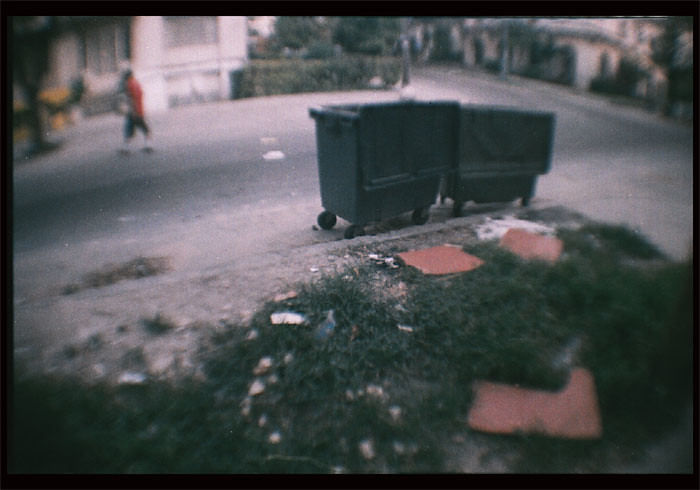
Photo: Claudio Fuentes Madan

One of the new self-employment "activities" approved by the Cuban government is the controversial "recyclers-sellers of raw materials." This toughest “private enterprise” encompasses Havana’s beggers who survive on collecting what the rest of the society throws out.

Several years ago Claudio Fuentes Madan was making a series of paintings using the city’s waste, which brought him into contact with many of these men and women who eat, literally, garbage. For the most part they are people without homes (and no possibility of acquiring one since buying and selling property is forbidden to Cubans). They spend the night in the most sinister places in the city (areas of destroyed hospitals, abandoned buildings declared uninhabitable because of the risk of collapse, parks far from the center, and that part of the urban landscape that is essentially shanty towns). They often live as “illegals,” under a Stalinist law that prevents anyone without a permanent address in Havana from staying in the city. To prevent disease, Claudio told me, they mix gasoline or kerosene into the water they use to bathe with, which they do at the home of an acquaintance, paying a modest rent in advance for the use of the sanitary services.

These are people who from now on will have to pay a percentage of their earnings to the Cuban state. It’s so sadistic it’s hard to imagine. You feel like covering your eyes with both hands like during the bloody scenes in terror movies. But this isn’t a movie, it’s what remains of the socialist economy.

One wonders why this business appears to be -- I can’t think of another adjective -- prosperous enough for the State to decide to relieve its beneficiaries of a portion of their earnings. It turns out that true civics, that legendary course that my parents studied in primary school and I did not, has lost its semantic meaning in Cuba. People do not feel responsible for recycling the trash: if the state needs raw materials, that’s its problem. That’s why the recycling centers -- the “offices for the recollection of raw materials” -- are ignored; only the dumpster divers bother to take there the plastics and cans that they find in the garbage cans.

The other day a friend collected all the bottles that had accumulated in his home over the years, and set out -- the paradigm of the New Man -- to take them to the closest center. On arriving he discovered he had to take all his “recyclable material” home again, because he didn’t bring them in a sack consistent with what they would accept. Late that same night he gave them to a girl with a cart collecting rubbish in the city. She had changed her work schedule from three in the afternoon to three in the morning.

Thursday, October 7, 2010

Spontaneous

Photo: Claudio Fuentes Madan

I've been left a little traumatized after the celebrations of the CDR. Between the discussion on the bus, my neighbors’ Sunday volunteer work, and the reggaeton on the 28th until 1:00 in the morning; right now I feel a sense of "been there, done that... and never again would be too soon."

It turns out that Sunday was a “voluntary workday.” Obviously El Ciro and I weren’t aware of this, so when he went downstairs with the dogs and found an old man weeding the grass, with his last ounce of strength, he said, “Compadre, let me do it, I’m younger.” So as he cleared the block of every weed, “the guy with the list” approached and said, “Hey compadre, leave that, it’s already been checked off.” El Ciro looked up and discovered that in addition to having taken part in voluntary work, he was, in effect, the only one who had actually done any work. As for the others, it was grab a brick, move it from the right to the left, and then look at the guy with the list and say, “check me off.” I remembered the time the mutt broke the light on the stairs and El Ciro (one hundred percent private initiative) changed it without saying anything to anybody. A neighbor told me later that a meeting had been planned to define a repair strategy: “How much money to be collected from each apartment, who would collect it and who would spend it.” We had skipped all the steps.

For the party it was the same. In my building, by ten o’clock at night, the only person awake is me. My poor neighbors closed their eyes four hours later because they “had to celebrate” September 28th, the fiftieth anniversary of the Committees for the Defense of the Revolution (CDR).  After midnight I heard an innocent neighbor ask why they hadn’t had the party on Friday or Saturday. Poor thing, she doesn’t know that you dance on the scheduled day, you work on the scheduled day, you sleep on the scheduled day and you live according to the schedule.

Sunday, October 3, 2010

The Male

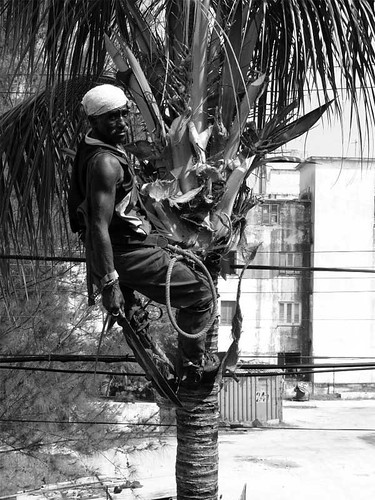
Photo: Claudio Fuentes Madan

I don’t consider myself a feminist because I try to avoid reactionary attitudes. That is to say, feminism in opposition to machismo seems too easy to me when in really my rights as a human being go far beyond my gender. Among some of my acquaintances, however, the issue is less complex: I am a feminist. We have a natural tendency to throw into the sack of the known anything that we do not understand, the extreme generalization of the exceptions that don’t fit the statistics.

In Cuba machismo works like racism, for the leadership of the Cuban Communist Party it simply “doesn’t exist.” In her book, The Second Sex, Simone de Beauvoir studied the points of convergence between the segregation suffered by black people and women; half a century later my country is living proof of her thesis. Among the “not racists” are those who assert that “not all blacks are the same” or this aberration, “this black man has a white soul.” Among the “no machismos” we find another version of the same phenomenon, “the woman is like us.” In other words, “men” are the species, and “we women” resemble them.

The other day I went to a party far from Central Havana and got lost on the way, one of the guests recognized me on the street and as he was in a taxi, he picked me up. When I got in he was in a lively conversation with the driver that I didn’t want to interrupt. The dialog went more or less like this:

“But man, I don’t let her go out alone. Why does she need to be running around out there by herself?”

“I agree.”

“Sometimes when I get home from work, I knock her around a little, just in case.” I suppose this comment was a joke, but I can’t prove it. And then he added, “Later she stands in front of the mirror and I tell her, ‘You see? I’m better looking than you.’”

It hit me like a brick, not only because of the bad taste of what appeared to be a joke, but for the fact that they both ignored my presence in the back of the car, big time. When we got to the house where the party was, the guy who had recognized me turned to me and asked, “Claudia, do you happen to have any money? You pay, I don’t have the exact change.”

Wednesday, September 29, 2010

Subtleties of the Jaw

 Photo: Claudio Fuentes Madan

The line for the bus at Coppelia is a special place, one of the corners so eloquent that if it disappeared one day Havana wouldn’t be the same. Yesterday at ten at night I was waiting for my P4 bus when a woman standing next to me with her daughter commented how “alive” the city was for the anniversary party for the Committees for the Defense of the Revolution (CDR). “Is that a joke, ma’am?” I asked, and she gave me a serial killer look.

The driver swore that not one more person could fit on the P4, so I got on through the back door. A drunk behind me was pushing to cut the line, but he was staggering around and trying to hold onto his bottle of alcohol at all costs and he lost his balance and fell. The driver started while the man was still trying to get on and he was almost killed in the attempt.

The woman of the “lively party,” at my side started screaming, and me, I answered, “He’s so plastered he won’t even make it to the corner!” She added, “He had to be black, all blacks are the same,” and started a lecture all about “those blacks” which if Martin Luther King had heard he would have died a second time. I looked around embarrassed. Everybody nearby was white. No one opened their mouths and I realized that they would all remain mute rather than defend the blacks. I got hysterical, I regretted it later, but at the time I wanted to strangle her, especially since her ranting was quietly being listened to by her young daughter, what a great example!

“Madam,” I said to her, “if I scream ‘Down with Fidel!’ you would be the first to jump on it. May I ask, then, why I have to put up with you talking like you’re the president of the Ku Klux Klan? And if I scream, ‘Down with Estaban Lazo!’ are you going to jump on that too or is it not the same?” The phrase came out rather awkwardly. She said nothing. People were staring at me and soon I felt like I’d stepped out of a tomb at the Colón cemetery, with worms crawling out of my half-gone skull.

I knew I couldn’t stop myself. That should not be the approach to dialog but sometimes dialog is simply beyond my capacity for tolerance. I got off at the stop at 23rd and A and walked the half mile home, talking to myself.

Saturday, September 25, 2010

El Dorado and the 21st Century Left

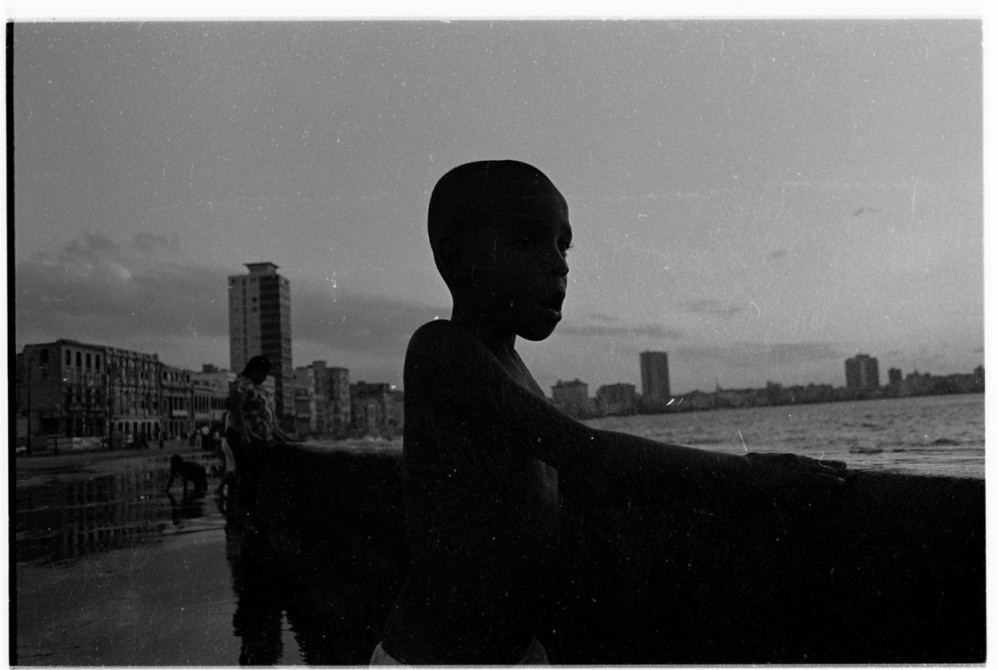
Photo: Leandro Feal, from the series "Trying to live with swing.”

My only certainty is that I am not a communist, the rest I’m not that sure about. I have trouble defining myself politically. It could be the result of having been born into a system different from the rest of the world -- outside its definitions of right and left -- into a system based on one man and above all, on his whims. I love listening to people when they explain their political positions to me (including the orthodox, of course), and it disappoints me not to be drawn to any. Beyond the rights and freedoms of man, there is no cause I feel committed to.

But one reads, is informed, and strives to understand the world, especially the ideologies that move it. Rather than get on a plane, the four hundred pages of a book -- nearly destroyed by its great many readers -- or a documentary on a flash memory, tell me the story of humanity beyond the sea. In general, I have decided to establish margins for a minimum comparison so as not to drive myself crazy. It is not very useful, from my point of view, to try to compare a democracy with a system of State capitalism, or a dictatorship with a developing country. I can compare the United States with Europe, Mexico with Argentina, Chile or Haiti; Cuba with the former countries of the Soviet Union, with Iran, with the Chile of Pinochet, the Spain of Franco, and even North Korea. Any other comparison, Cuba versus Uruguay for example, is tainted by a primary antagonism: Totalitarian Society versus the Rule of Law.

Thus, when a European unionist tries to convince me of “the achievements of the Cuban Revolution,” it makes me want to cry. First, because there are no unions in Cuba, at least not what would historically be known as a workers’ union, whose function is to enforce the rights of the worker versus the boss, the company or the State. It would be healthy to get to the root of the concept, to respect the meanings of nouns so as not to fall into ambiguity; as my friend Reinaldo Escobar says, “Bread means bread and dictatorship means dictatorship.”

On this point, the paths of the left, unfortunately, tend to greatly confuse me. So I find people who condemn all the dictatorships in the universe except for the one in my small country, and who are insulted when they hear Franco spoken of with respect, yet they venerate Fidel Castro. Others hate the western press for its sensationalism, but don’t criticize that a single party controls our newspapers.

There are those who are sure that the politics of the United States are interventionist and hegemonic, but they served as soldiers in Nicaragua, Angola and Ethiopia. There are even those who protest on the streets of New York against the war in Iraq with a three-by-three-foot poster of Ernesto Guevara. People, in short, who call the government of my country, “The Revolution.”